
AI in Your E-Shop: 4 Real Ways It Saves Time in 2026
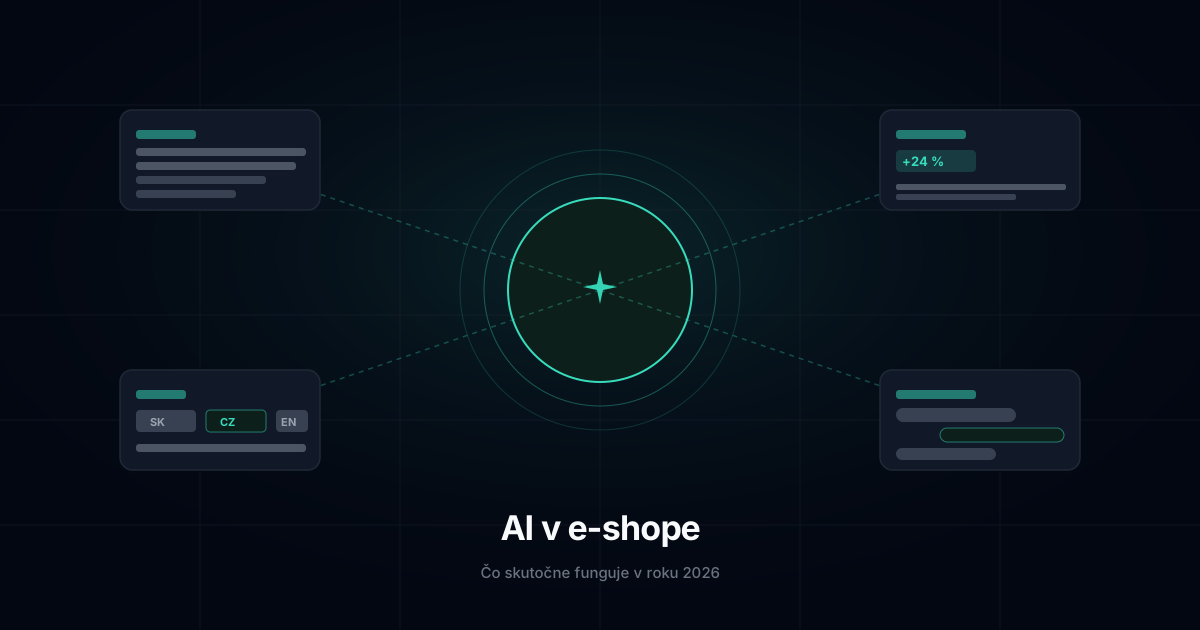
In 2024, “AI in your e-shop” sounded like a marketing term. In 2026, it’s a concrete tool that saves 5–10 hours per week for any store owner who uses it correctly.
The question is no longer “does AI work?”. It’s: what exactly does it help with, and what doesn’t it?
Here are 4 real use cases that make sense in 2026. Plus one that still doesn’t.
1. Product descriptions (biggest time-saver)
The most common use case. Instead of writing 200 descriptions by hand, you feed in parameters — name, category, material, key features — and AI generates a SEO-friendly description in 10 seconds.
What to watch:
- Verify facts. AI sometimes adds a specification the product doesn’t have.
- Define your tone-of-voice (formal / casual / expert) and keep it consistent in prompts
- Add the keyword naturally, not 5×
Real impact: a 500-product store saves 70+ hours on the initial catalog and 1–2 hours per week on new products.
2. Multi-language translations (2026 quality is dramatically better)
Translations via DeepL or GPT-4 were usable in 2022. In 2026, models like Claude Sonnet 4.6 (which powers Merzio AI) reach a level where translation between Slavic languages is often indistinguishable from a human translator.
Practical use:
- A store expanding from one country to another — translating 200 products, categories, and metadata in a few hours
- Generating multilingual newsletters in a single campaign
- Localizing product feeds for marketplaces like Heureka, Glami, or Google Shopping
Caveat: for narrow technical fields (medical, legal), still prefer human review before publishing.
3. Analytics and daily decisions
This is where 2026 AI differs the most from a simple chatbot.
An assistant that sees your data (orders, stock, customers) can answer questions like:
- “Which product had the biggest revenue drop this week?”
- “Which products haven’t sold in 60+ days?”
- “Do I have any reserved products with no stock?”
Without AI this means three separate reports — Google Analytics, your admin, your stock dashboard. With AI it’s one question. We covered this in detail in Merzio AI: the assistant that actually knows your store.
4. First-line customer support
40–60% of customer questions are repeats: “When will my package arrive?”, “What sizes do you have?”, “How do I return an item?”.
An AI agent connected to your data (order status, stock, terms of service) handles these without your intervention. You only step in when something is non-standard.
According to the European Commerce Association APEK, Czech e-shops alone employed around 90,000 people at the end of 2023, with customer support being a significant share. Even 30% automation has a meaningful economic effect.
And one use case that still doesn’t work: fully autonomous ad campaign management
In 2026, AI still can’t independently outperform an experienced human at setting up Google Ads / Facebook campaigns. It’s a good assistant — keyword suggestions, performance analysis, generating ad variants — but final decisions should still belong to a person. Don’t underestimate this line.
Build vs. add-on: where should AI live?
Three approaches you see today:
- External tool (ChatGPT, Claude.ai) — copy-paste workflow. Works, but productivity suffers.
- Add-on / plugin — connected, but doesn’t see all data. Often more expensive too.
- Built into the platform — sees data, runs in the admin panel, no integration needed. Most efficient.
Most CZ/SK platforms (Shoptet, Upgates, Eshop-rychle) in 2026 still don’t have AI built in anywhere. Merzio does — included in all plans, built on Claude Sonnet 4.6.
AI in 2026 isn’t a revolution. It’s a tool that saves concrete time on concrete tasks. The biggest mistake we see: people expect miracles and don’t try specific use cases.
Try Merzio AI free for 14 days with real data from your store, or see which features are included in your tier.